Hyderabad was once celebrated as India's most affordable metro. That title no longer applies. Property prices across the city have surged nearly 85% in five years, pushing the average home transaction past ₹1.15 crore — a number that places ownership out of reach for nearly 70% of local residents. For middle-class buyers, the picture is stark. A software engineer earning ₹12 lakh a year, who could have comfortably bought a 2 BHK in Kondapur five years ago, now faces an EMI that would swallow over 75% of their take-home pay for the same apartment. Families are being pushed to far-flung suburbs. Renters are watching rents climb 11.5% quarter on quarter. And developers, chasing higher margins, keep building luxury — not the affordable housing the city desperately needs. In this article, HomeMan breaks down exactly what's happening, neighbourhood by neighbourhood — and what genuine options still remain for buyers in 2026.
The Numbers Behind the Headlines
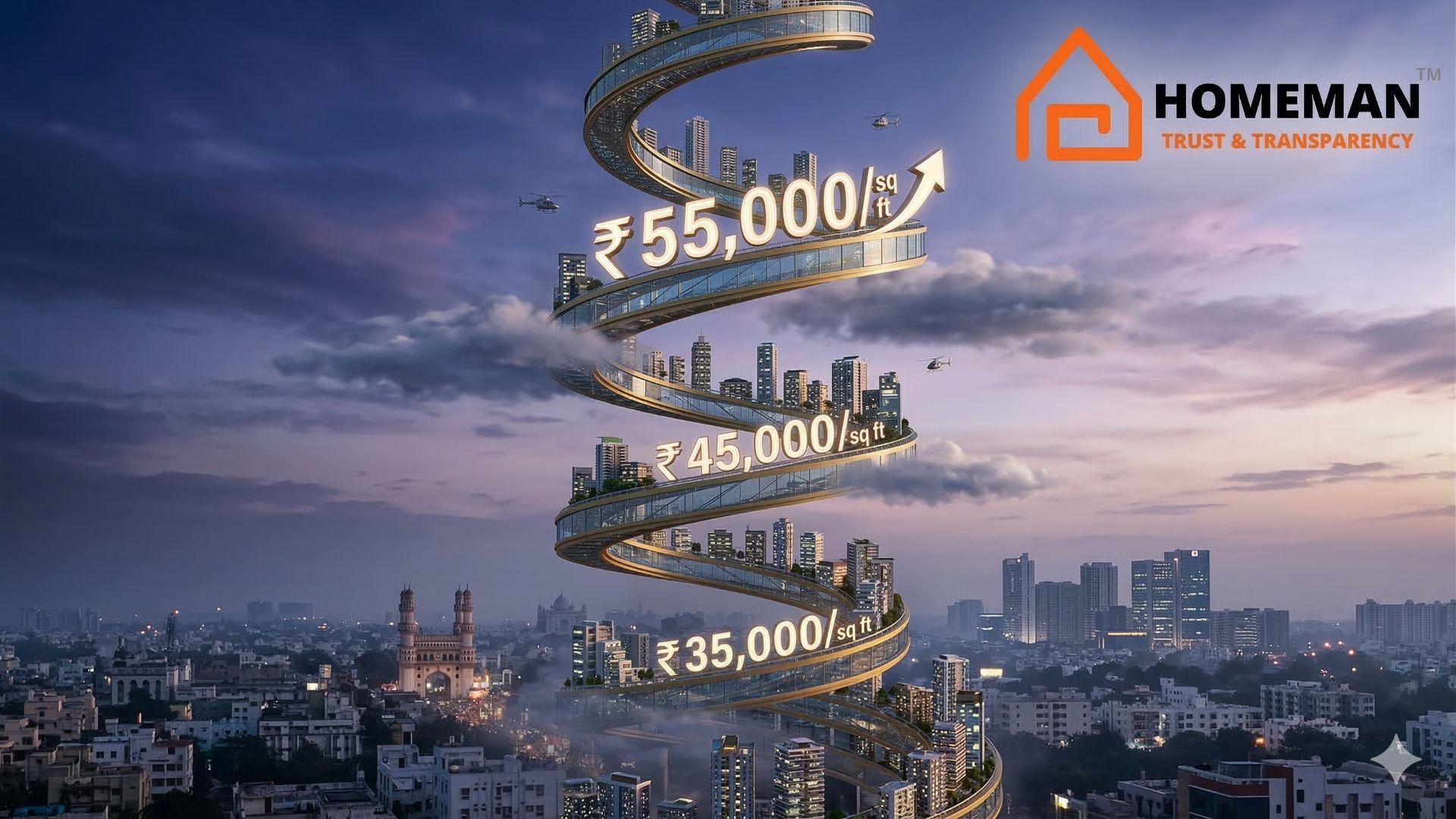
The scale of Hyderabad's real estate surge becomes starkest when you look at individual neighbourhoods. Kokapet — barely a blip on the property map five years ago — now commands rates of more than ₹9,000 per square foot for premium apartments. Narsingi and Gachibowli are close behind. The western corridor as a whole has seen prices skyrocket by over 50% in just five years, with another 10–20% rise projected in the near term.
The numbers from H1 2025 tell the full story of what's happening at the top end. Luxury homes priced above ₹1.5 crore saw sales surge by 450% nationally since 2021 — and Hyderabad led this charge, with 8,205 premium homes sold in the first half of 2025 alone. The city now has luxury stock making up 35% of its total housing supply, the highest share among Indian metros.
"Property prices in the city have surged by around 85% over the past five years, pushing the typical home cost past ₹1 crore — a level that places ownership out of reach for nearly 70% of local residents."
Meanwhile, weighted average transaction prices grew 15% year-on-year in June 2025 alone. In the Rangareddy district, residential values rose by 20%. These are not incremental, gradual movements. These are the kind of numbers that rewrite family financial plans in the space of a single year.
Price Per Square Foot Across Key Areas (2026)
| Area | Price per Sq Ft | 5-Year Change | Affordability |
|---|---|---|---|
| Kokapet | ₹9,000 – ₹12,000 | +50%+ | Out of reach |
| Gachibowli / HITEC City | ₹8,500 – ₹15,000 | +45% | Out of reach |
| Banjara Hills / Jubilee Hills | ₹11,000 – ₹20,000 | +38% | Ultra premium |
| Kondapur | ₹7,500 – ₹10,000 | +40% | Stretching |
| Manikonda | ₹5,500 – ₹7,500 | +35% | Mid-range |
| Kompally / Yapral | ₹4,000 – ₹5,500 | +25% | Accessible |
| Patancheru / Shamshabad | ₹3,500 – ₹5,000 | +20% | Affordable |
Why Is This Happening? The Real Drivers
Understanding the surge requires looking beyond the simple "IT jobs = more buyers" narrative. Several forces are feeding each other simultaneously.
The IT Sector's Gravity
Hyderabad has earned its "Cyberabad" nickname. Microsoft, Google, Amazon, and scores of global tech firms have expanded their presence significantly. The HITEC City and Financial District remain hotspots, and newer tech parks are emerging in both eastern and western corridors. Every new tech campus creates a ripple: employees need housing, restaurants, schools — and each of those creates demand for more space. The IT sector is not just an employer here; it is the engine of the entire property market.
Infrastructure Unlocking New Zones
Metro Phase 2 is adding 86 km and 32 new stations. The Outer Ring Road expansion has made suburbs accessible that were considered too far just three years ago. When commute times drop, land prices rise — and developers have been quick to capitalise on every infrastructure announcement. Areas like Tellapur and Narsingi were peripheral villages until the ORR put them 25 minutes from Gachibowli. Now a 2 BHK there costs ₹90 lakh.
NRI and Investor Demand
For an Indian professional earning in dollars, pounds, or dirhams, the exchange rate makes Hyderabad property look extraordinarily cheap. A ₹1.5 crore apartment that feels expensive to a local IT employee earning ₹12 lakh per year represents roughly $180,000 — a fraction of what equivalent property costs in any major Western city. NRI purchases have surged, and they compete directly against local buyers for the same stock.
Developer Strategy: Build Luxury, Skip Affordable
Here is the structural problem that rarely makes it into real estate market reports. Builders earn significantly higher margins on luxury projects than on affordable housing. So when land prices rise, developers' rational response is to build fewer, larger, more expensive units — not more affordable ones. The result, as multiple analysts have pointed out, is a city where the unlimited Floor Space Index (FSI) policy has produced an oversupply of high-end inventory and a severe shortage of homes priced below ₹60 lakh.
The affordability gap in numbers: The sub-₹50 lakh housing segment fell by 3% in early 2025 while properties above ₹1 crore surged by 12%. Affordable housing demand has dropped from 37% of total sales in 2021 to just 18% in 2025 — not because buyers don't want affordable homes, but because developers stopped building them.
The Human Cost: Who Is Actually Being Hurt
Real estate data points are easy to read as abstract numbers. They are less abstract when you consider what they mean for specific people trying to build a life in Hyderabad.
The Young IT Professional
Consider a software engineer at a mid-tier IT firm earning ₹10–12 lakh per year — solidly middle class by Indian standards. Five years ago, a 2 BHK in Kondapur was within reach with a manageable home loan. Today, the same apartment costs ₹85–95 lakh. At standard home loan terms (8.5% interest, 20-year tenure), the monthly EMI on a 80% loan would be roughly ₹67,000 — nearly 75% of their take-home pay. Ownership, for this person, has become mathematically impossible without family financial support.
Middle-Class Families Being Pushed to the Periphery
Middle-income families who cannot afford central areas are being pushed to far-flung suburbs like Tukkuguda and Maheshwaram — where homes below ₹1 crore can still be found, but at the cost of 1.5–2 hour daily commutes and weaker access to schools, hospitals, and services. This is not just a financial trade-off. It is a quality-of-life regression. Hours lost to commuting are hours not spent with family, not spent sleeping, not spent living.
Renters Bearing a Double Burden
For those who cannot buy, the rental market offers no relief. Rents in Hyderabad rose 11.5% quarter-on-quarter in 2025 — one of the sharpest increases among all Indian cities. When elevated sales prices prevent people from buying, they stay in the rental market longer, pushing up demand and rent simultaneously. Rents in HITEC City and Gachibowli have grown 2.5–3% per quarter even in 2026, a market that is supposedly "stabilising."
Those Turning to Unregulated Builders
Some buyers, priced out of RERA-compliant projects, are turning to unorganised builders and smaller developers offering lower prices. This raises serious concerns. Without RERA oversight, buyers have fewer protections against project delays, quality issues, and outright fraud. The desperate search for affordability is pushing people into exactly the situations that RERA was designed to prevent.
Rising Costs Beyond the Price Tag
The purchase price is only part of the story. The full cost of homeownership in Hyderabad in 2026 includes several compounding burdens that are getting heavier alongside property prices.
Registration Values Set to Jump 30–50%
The Telangana government is preparing a 30–50% hike in official property registration values to bring them closer to market rates. This means stamp duty and registration charges — already a significant upfront cost — are set to increase proportionately. On a ₹1 crore property, registration charges at revised rates could add ₹5–7 lakh to the upfront cost. For buyers who are already stretching to arrange a down payment, this is a serious blow.
Home Loan Rates Biting Harder
Home loan interest rates have risen approximately 2% since 2023. On a ₹70 lakh loan, that 2% increase adds roughly ₹10,000 per month to the EMI. Stagnant wages and rising loan costs are squeezing middle-class buyers from both sides simultaneously.
Maintenance Costs in Premium Complexes
As developers shift to luxury gated communities with infinity pools, clubhouses, and smart home features, maintenance charges have risen sharply. Monthly maintenance of ₹8,000–₹15,000 is now standard in many western corridor developments — adding ₹1–1.8 lakh per year to the cost of ownership on top of the EMI.
Is There Any Good News?
It would be unfair to present only the pressures without acknowledging where genuine opportunities still exist. The picture is not entirely bleak.
Eastern and Northern Suburbs Still Offer Options
Areas like Kompally, Yapral, Ghatkesar, Hayathnagar, and LB Nagar still have 2 BHK apartments available in the ₹40–60 lakh range. These are genuine, liveable localities — not isolated outposts. They benefit from improving road connectivity and, importantly, they have not yet been priced up by the same NRI and investor demand that has overwhelmed the western corridor.
Under-Construction Projects Offer Entry Points
Under-construction apartments in emerging areas like Patancheru and Shamshabad offer prices significantly below ready-possession rates. For buyers who can absorb a 2–3 year wait (with RERA protection), these represent one of the few remaining paths to ownership at manageable prices. Patancheru, in particular, saw 2 BHK flats listed at ₹60 lakh in 2025 on our own platform — a level that is still within reach of dual-income households.
Interest Rate Moderation Expected in 2026
Economists and market analysts broadly expect home loan interest rates to moderate in 2026 as the RBI eases monetary policy. Even a 0.5% rate reduction translates to a meaningful reduction in monthly EMIs and could bring some buyers who were on the fence back into the market.
HomeMan's view
If you are a genuine end-use buyer — meaning you need a home to live in, not to flip — the worst thing you can do is wait indefinitely. Peripheral areas that look inconvenient today will look like smart decisions in three years. The infrastructure is coming. The question is whether you buy before or after the market prices it in.
The Bottom Line
Hyderabad's real estate market is thriving — if you measure success by transaction values, luxury sales volumes, and NRI interest. By those metrics, it is one of the best-performing property markets in India.
But markets do not exist in a vacuum. A city where teachers, nurses, government employees, and mid-career IT professionals cannot afford to own a home within commuting distance of their workplace is not a healthy market — it is a divided one. The long-term social and economic costs of that division are real, even when they do not appear in quarterly sales reports.
If you are navigating this market as a buyer, renter, or property owner, the most important thing you can do right now is make decisions based on your actual financial position — not on fear of missing out, not on speculation, and not on the assumption that prices will always go up. They have not always gone up everywhere. And even in markets where they do, they do not go up at the same pace for everyone.
HomeMan exists to help real people — not just investors — find a home they can actually afford, in a location that works for their life. If you need guidance on what is genuinely available in your budget, reach out to us.