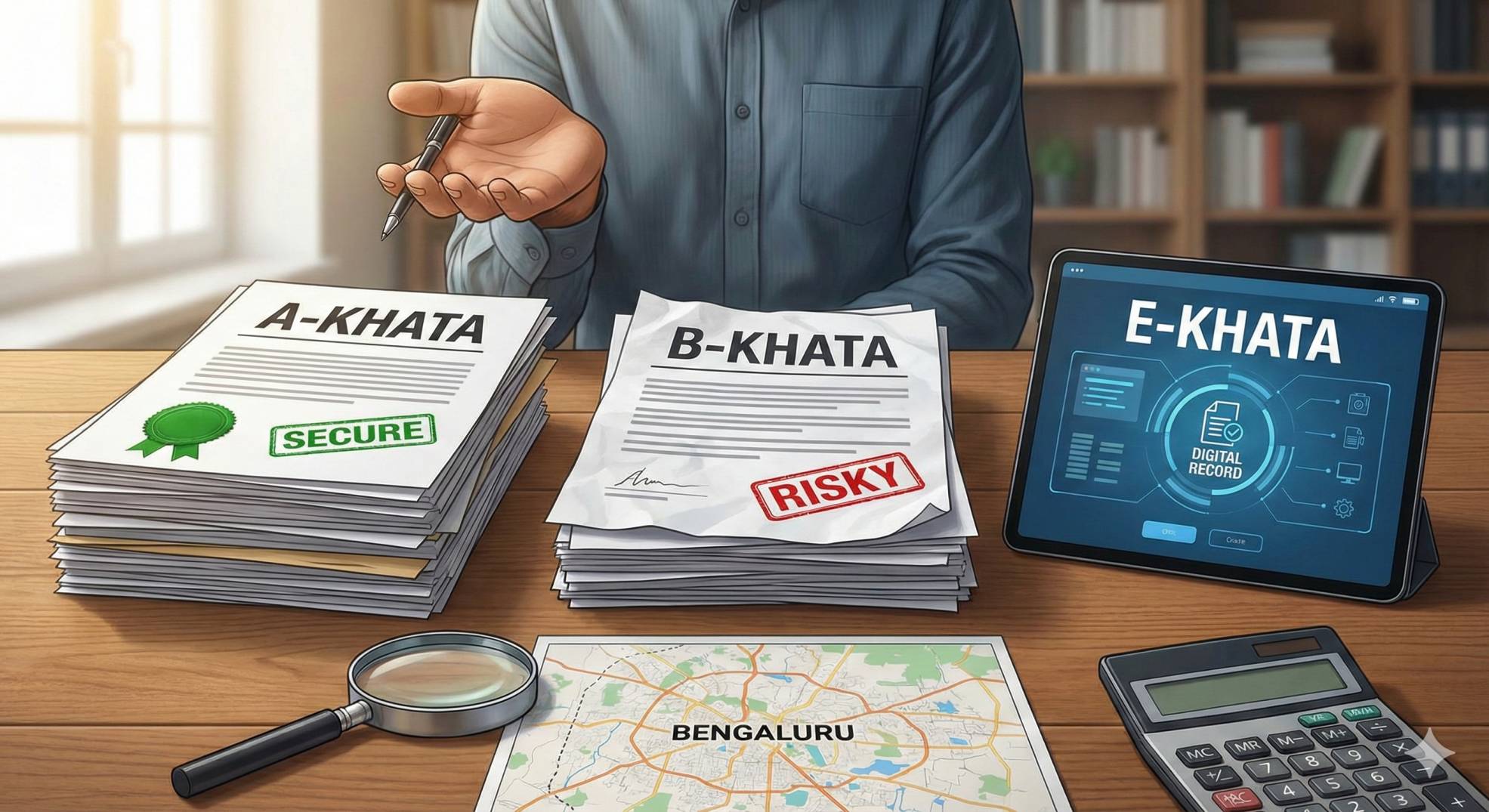
1. The Basics: What is a Khata?
First, let’s clear up a common myth: A Khata is NOT a title deed.
A Khata is essentially an account with the BBMP (Bruhat Bengaluru Mahanagara Palike) for paying property taxes. However, it has evolved into a crucial document for identification and loans.
2. A-Khata vs. B-Khata: The Critical Difference
| Feature | A-Khata (The Gold Standard) | B-Khata (The "Temporary" Fix) |
|---|---|---|
| Legality | Fully legal. Complies with all building bye-laws and government regulations. | technically "irregular." Often issued for properties with deviations or in unauthorized layouts. |
| Loans | Approved by all nationalized and private banks (SBI, HDFC, etc.). | Denied by most nationalized banks. Only select NBFCs might fund these at higher interest rates. |
| Permits | You can legally expand or renovate your home. | You cannot get building plan approval for expansion. |
| Resale | High resale value; easy to sell. | Lower resale value; harder to find buyers due to legal fears. |
HomeMan Insight: It's not suggested to buy a B-Khata property thinking you can "easily" convert it later. While conversion schemes exist, they are expensive, time-consuming, and not guaranteed for every property.
3. The Game Changer: What is E-Khata?
This is where the market has shifted. As of October 2024, the Karnataka government made E-Khata mandatory for all property registrations.
What is it?
An E-Khata is a digitized, tamper-proof version of your Khata. It assigns a unique PID (Property Identification Number) to your property.
Why is it a Game Changer?
- Stops "Double Selling": In the past, scammers could sell the same site to two different people using manual documents. With E-Khata, the property is digitally locked to one owner.
- Mandatory for Sale: You technically cannot register a Sale Deed in the Kaveri system (the government registration portal) without a valid E-Khata.
- Verification: It forces sellers to come clean. To get an E-Khata, a seller must upload their Aadhar (eKYC), Sale Deed, and Encumbrance Certificate (EC). If their papers are messy, the system rejects them.
4. How Does This Affect You as a Buyer?
If you are looking to buy in 2026, here is your new checklist:
Ask for the 10-Digit PID: Don't just look at paper documents. Ask the seller for the property's PID and check if the E-Khata is in the "Final" stage (not just "Draft").
The "Draft" Trap: BBMP initially issued "Draft E-Khatas" to everyone. This is just a preliminary record. The owner must have converted it to a "Final E-Khata" by submitting their documents. Only a Final E-Khata allows for a sale.
B-Khata in the E-World: Even B-Khata properties are being digitized into the E-Khata system, but they will still be flagged as non-compliant. The E-Khata doesn't magically make a B-Khata legal; it just makes the status transparent.
Conclusion: Don't Navigate This Alone
The shift to E-Khata is great for transparency, but it adds a layer of technical due diligence to the buying process. A missing E-Khata can delay your registration by months or kill the deal entirely.
At HomeMan Properties, we don't just find you a home; we verify the digital footprint of every listing. We ensure the property you fall in love with is a property you can legally own.